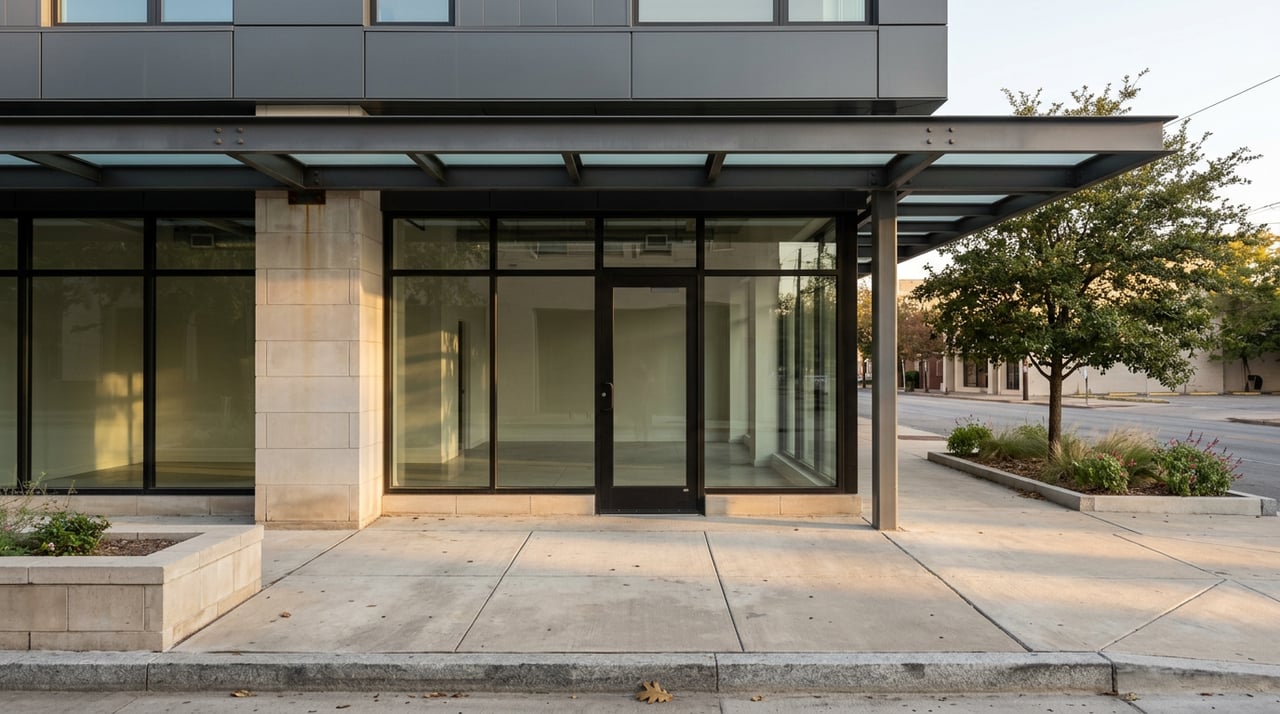
In March 2020, Trammell Crow Company and its residential arm, High Street Residential, told Austin exactly what was coming to the corner of East Martin Luther King Jr. Boulevard and Alexander Avenue. The announcement was specific: a 280,000-square-foot mixed-use project called The Block Yard, sitting on four acres directly next to the MLK MetroRail station, anchored by a standalone 63,800-square-foot creative office building with 14-foot floor-to-floor ceilings and 4,200 square feet of ground-floor retail. CBRE's Katie Ekstrom, who was leading the leasing effort with Troy Holme, framed it as filling a real gap. Quality creative office was scarce on that stretch of the East Side, and this building was going to be the answer.
Four years later, the answer never showed up in the form it was announced. The property that opened in July 2024, now known as The Blockyard, is a 344-unit apartment complex with live/work lofts on the ground floor. Not a separate office building. Not the 63,800 square feet of dedicated creative office space CBRE was marketing. The residential architects at JHP and the interior team at Levy Dykema both describe the same thing happening in between: the ground floor, originally designed with commercial space in mind, was reworked into flexible live/work units as a direct response to the shift in demand that COVID caused.
That is the part of this story worth sitting with if you are a creative tenant or a small investor sizing up this corridor. A well-capitalized developer, backed by a Fortune 500 parent company, planned and marketed a specific amount of creative office space at a specific transit-adjacent address, and the market moved before the building did. If it can happen here, a press release describing square footage on the East Side is a starting point for due diligence, not a substitute for it.
What was announced versus what got built
The gap between the 2020 pitch and the 2024 delivery is large enough to lay out side by side.
| Announced (March 2020) | Delivered (July 2024) | |
|---|---|---|
| Total project size | 280,000 sq ft mixed-use | 344 residential units |
| Creative office | 63,800 sq ft, standalone building, 14-ft ceilings | None built as a separate structure |
| Ground-floor retail | 4,200 sq ft | Absorbed into live/work residential lofts |
| Residential units | 302 apartments | 344 units, studios through three-bedroom |
| Original completion target | Office: July 2021. Residential: January 2022 | Full project: July 2024 |
| Design intent | Transit-oriented office and retail anchor | Live/work lofts facing MLK Blvd, quarry-inspired facade referencing the site's industrial history |
The residential count itself grew by 42 units between the pitch and the delivery, and the completion date slipped roughly three years past what was originally announced for the office component alone. This was not a minor value-engineering tweak. The entire commercial half of the program was reabsorbed into the residential half.
There is a second layer to this corner that most coverage of The Block Yard leaves out. Listings for that same address, 2900 East MLK, once described a creative office building called Cityline at MLK Station, pitched with open ceilings, stained concrete floors, a rooftop terrace, and direct access to the MetroRail stop. Whatever became of that building, the site was where Trammell Crow proposed its 2020 mixed-use project, and the creative office space promised there never got built either. This is not a story about zoning or a single bad decision. It is a story about how quickly office demand can move against a site that looks, on paper, like it should be a lock.
Why the office component disappeared
The explanation both architecture firms give is straightforward: the pandemic changed what tenants wanted at exactly the moment the project would have been pre-leasing its office floors. A 63,800-square-foot creative office building depends on employers committing to space years before it opens. In 2020 and 2021, that kind of commitment from office users was close to impossible to secure, while apartment and live/work demand held up. High Street Residential had the multifamily expertise and the capital structure to pivot the ground floor toward what renters were actually asking for. The building's facade still nods to the site's history as a quarry and masonry yard, and the project still connects to the EastLink trail and a shared half-acre park, but the working office floors that were supposed to sit above that retail base were never built.
This is worth separating from a zoning story or a permitting story. Nothing about Austin's land use rules stopped this office building from getting built. The market for pre-committed creative office space on this stretch of MLK simply was not there when the developer needed tenants to sign.
What actually exists on the corridor today
If you are looking for creative office space along East MLK right now, you will not find one large anchor building holding it. What you will find is a handful of smaller, flexible operators who filled in around the gap:
- FUSE Workspace opened its fourth Austin-area location at 2105 East MLK Boulevard in fall 2024, with a public grand opening on October 22 of that year. The building is a joint venture between FUSE and its original developer, CB Capital, and offers private offices, coworking desks, and meeting rooms rather than a leasable floorplate a growing team would build out on its own.
- The Station on Manor, at 2815 Manor Road, markets itself as stand-alone plug-and-play creative office space roughly four-tenths of a mile from the MLK MetroRail stop, in the Rosewood area.
- The Malin operates a creative coworking location in East Austin as well, part of the same membership-driven model.
None of these are what CBRE was describing in 2020. They are smaller-format, flexible, and built around monthly or annual memberships rather than a five- or ten-year office lease with a build-out allowance. For a small creative team that wants its own identity, its own signage, and space it can shape from a raw shell, the corridor's actual current inventory looks different from what the headline pitch promised six years ago.
What this means for a tenant or an investor
If you are a creative or tech tenant looking at this stretch of MLK, the lesson is not that the corridor is a bad location. The MetroRail stop is real, the trail connection is real, and the neighborhood has kept adding restaurants and retail along MLK in recent years. The lesson is that a corridor's marketing story and its delivered inventory can be two different things, and the gap between them is where a tenant either finds a genuine opportunity or signs a lease based on a building that no longer exists in the form it was described.
For an investor evaluating a small acquisition near this stop, the same caution applies in reverse. A pre-leasing narrative built around transit access and creative-office scarcity is a useful signal, but it is not underwriting. Ask what was actually delivered on comparable projects in the same submarket over the same cycle, not just what was announced.
This is exactly the kind of groundwork we walk through with tenants and owners before they sign anything on the East Side. If you are weighing a space near the MLK corridor, whether it is a small footprint for a growing team or a building you are considering buying, we can help you separate what a listing says from what the block actually supports. Take a look at how we approach tenant representation or browse what we know about the Austin market more broadly.
FAQ
Is Cityline at MLK Station still a working office building? Not under that name. Listings describe it as a creative office building at 2900 East MLK before Trammell Crow's 2020 mixed-use proposal for the same address, which opened in 2024 as the residential Blockyard.
Is the MLK MetroRail stop the same as Austin's planned light rail? No. The MLK stop referenced in this story is an established Capital MetroRail commuter rail station on the existing Red Line, which has served this stretch of East Austin since 2010. It is a different system from the Blue Line light rail that Austin Transit Partnership is currently designing under Project Connect.
Where should a small creative team actually look for office space on this corridor right now? Based on current, named inventory, the realistic options are flexible operators like FUSE Workspace at 2105 East MLK, The Station on Manor at 2815 Manor Road, and The Malin's East Austin coworking location, rather than a single large ground-lease building.
Does this mean transit-adjacent office projects in East Austin are a bad bet? Not necessarily. It means the promise stage and the delivery stage of a project can diverge under market pressure, and a tenant or buyer should confirm what was actually built before relying on what a six-year-old press release described.
Let's talk about your property.